Do your legs feel heavy, achy, or swollen by the end of the day? Maybe your socks leave deep marks around your ankles, or the skin near your ankles has started to look darker than it used to. Many people in Sugar Land, Missouri City, Stafford, and Richmond brush these changes off as the price of long workdays, long drives, or simply getting older. But ongoing leg swelling and heaviness can be a sign of a common circulation problem called chronic venous insufficiency (CVI).
The good news: CVI is usually manageable, especially when it is recognized early. In this guide, we explain what chronic venous insufficiency is, the symptoms to watch for, what raises your risk, how it is diagnosed, and which treatments and everyday habits can help.
What Is Chronic Venous Insufficiency?
Your arteries carry oxygen-rich blood from your heart to your legs. Your veins have the harder job: carrying blood back up to your heart, against gravity. To make that possible, leg veins contain tiny one-way valves that keep blood moving in the right direction.
With chronic venous insufficiency, those valves or the vein walls are weakened or damaged. Instead of flowing upward, some blood pools in the lower legs. Over time, the extra pressure in the veins can lead to swelling, skin changes, and, in more advanced cases, slow-healing sores called venous ulcers.
Venous disease is common. According to Cleveland Clinic, varicose veins affect about 1 in 3 adults, and chronic venous insufficiency affects roughly 1 in 20 adults, most often people over age 50.
Common Signs and Symptoms of CVI
CVI often starts with mild symptoms that are easy to ignore. Symptoms can develop slowly and may get worse over time. Watch for:
- Swelling in the lower legs and ankles, especially after standing for a while or at the end of the day
- Legs that feel heavy, tired, full, or achy
- Leg cramps, including cramps at night
- Itching, tingling, or a burning sensation in the legs
- Varicose veins (twisted, bulging veins near the surface of the skin)
- Skin changes, such as reddish-brown discoloration near the ankles or skin that becomes thick or leathery
- Open sores (ulcers), usually near the ankles, that are slow to heal
You may not have all of these symptoms. Some people notice only swelling; others mainly notice visible veins or skin changes. Because leg swelling has many possible causes, a proper evaluation matters.
Is It CVI or Something Else?
Swollen feet and ankles do not always mean a vein problem. MedlinePlus (from the U.S. National Library of Medicine) notes that leg swelling can also be linked to long car rides or flights, pregnancy, certain medications, injuries, infections, blood clots, and conditions affecting the heart, kidneys, or liver. That is why it is important to have new or persistent swelling checked rather than guessing at the cause. Never stop a prescribed medication on your own; talk with your provider first.
What Raises Your Risk?
Johns Hopkins Medicine and Cleveland Clinic list several factors that make chronic venous insufficiency more likely:
- A history of deep vein thrombosis (DVT), a blood clot in a deep leg vein, which is one of the most common causes of CVI
- Older age (risk increases after 50)
- Family history of vein problems
- Excess body weight, which adds pressure on leg veins
- Pregnancy
- Sitting or standing for long periods, common for teachers, nurses, retail workers, and anyone with a long daily commute
- Lack of physical activity
- Smoking
- Previous leg injury or surgery
How Is Chronic Venous Insufficiency Diagnosed?
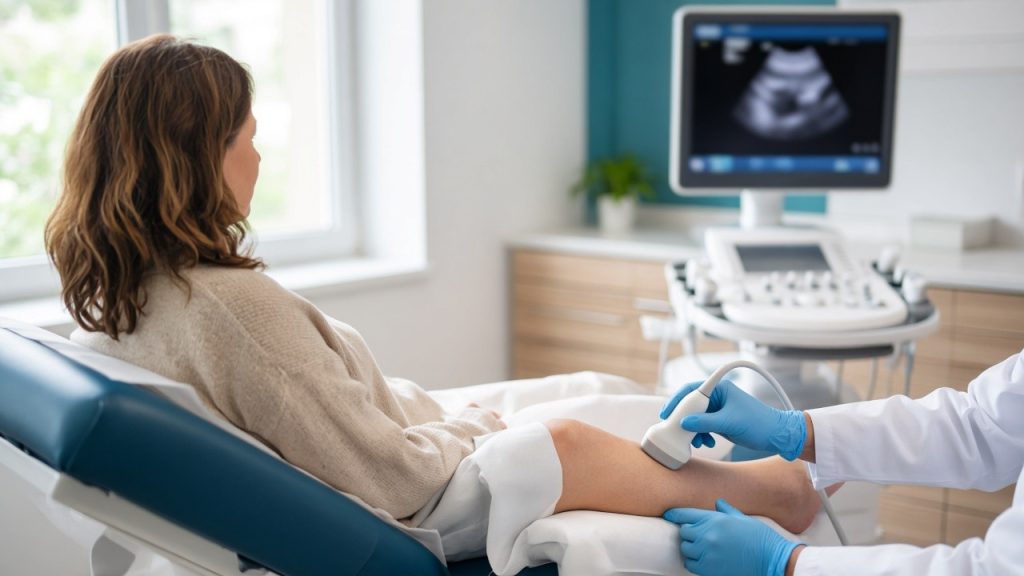
Diagnosis usually starts with a conversation about your symptoms and health history, followed by a careful look at your legs, skin, and any visible veins. The most common test is a duplex (vascular) ultrasound. It is painless and noninvasive, and it uses sound waves to show how blood is flowing through your leg veins and whether the valves are working properly.
Your provider may also check for other conditions that can cause similar symptoms. Cleveland Clinic notes that many people with CVI also have peripheral artery disease (PAD), a narrowing of the arteries, which matters because it can change which treatments are safe for you. At Texas Comprehensive Care, our diagnostic services include vascular ultrasound imaging to help evaluate blood flow.
Treatment Options for CVI
Treatment depends on how advanced your condition is, your overall health, and your goals. The aim is to improve blood flow, ease swelling and discomfort, protect your skin, and help any ulcers heal.
Lifestyle Changes
- Elevate your legs. Raising your legs above the level of your heart for short periods during the day can reduce pressure in your leg veins.
- Keep moving. Walking works your calf muscles, which squeeze your veins and help push blood back toward your heart.
- Take breaks from sitting or standing. On long drives or workdays, stand up, stretch, and flex your ankles regularly.
- Work toward a healthy weight with guidance from your provider.
- Avoid tight clothing around your thighs and waist.
Compression Therapy
Compression stockings or wraps apply gentle pressure to the legs to reduce swelling and support blood flow. They come in different strengths, and stronger stockings require a prescription. Because compression is not safe for everyone, especially people with significant PAD, ask your provider which type is right for you before you start.
Minimally Invasive Vein Procedures
When conservative care is not enough, a vein specialist may recommend an office-based procedure. Options can include endovenous thermal ablation, which uses laser or radiofrequency heat to close a damaged vein so blood reroutes through healthier veins, and sclerotherapy, which uses an injected solution to close smaller problem veins. Our Vein & Vascular Care team, led by Dr. Amit Sharma, a board-certified Vascular and Interventional Radiologist, offers compression therapy, vein ablation, and sclerotherapy.
Wound Care for Venous Ulcers
Venous ulcers can be slow to heal and may come back, so they need consistent, professional care. Treatment often combines wound cleaning, specialized dressings, and compression. Our wound care team works alongside our vascular specialist to support healing and help lower the risk of infection.
When to See a Specialist
Make an appointment with a doctor or vein specialist if you notice:
- Leg or ankle swelling that does not go away overnight or keeps coming back
- Heavy, aching legs that interfere with work, sleep, or daily activities
- New or worsening varicose veins
- Darkening, thickening, or itchy skin around your ankles
- A sore on your lower leg or ankle that is not healing
- Swelling that continues despite leg elevation and staying active
Get medical care right away if you have new swelling in only one leg, or a leg that is red, warm, or painful, since these can be signs of a blood clot or infection. Call 911 if leg swelling comes with shortness of breath or chest pain, which can signal a blood clot that has traveled to the lungs.
Frequently Asked Questions
Is chronic venous insufficiency dangerous?
CVI is usually not life-threatening, but it is a long-term condition that can worsen over time without care. Untreated, it may lead to skin damage, venous ulcers, and infections such as cellulitis. Early evaluation and treatment can help manage symptoms and protect your skin.
Are varicose veins the same as chronic venous insufficiency?
Not exactly. Varicose veins can be a sign of vein valve problems, but not everyone with varicose veins has CVI. CVI is typically diagnosed when there are additional signs such as persistent swelling, skin changes, or ulcers. Learn more in our article on varicose and spider veins.
Can compression stockings help?
For many people, yes. Compression therapy is a common first-line treatment that can ease swelling and discomfort. The right strength and fit matter, and compression may not be safe if you have significant peripheral artery disease, so check with your provider first.
How is CVI diagnosed?
Most people need a physical exam and a painless duplex ultrasound, which shows how blood is flowing through the leg veins and whether the valves are working properly.
Do I need a referral to see a vein specialist?
Referral requirements depend on your insurance plan. Call our office at 281-747-7620 and our team can help you understand the next steps.
Get Your Legs Checked in Sugar Land
If swollen, heavy, or aching legs are slowing you down, you do not have to just live with it. Texas Comprehensive Care serves patients from Sugar Land, Missouri City, Stafford, Richmond, Rosenberg, and the greater Houston area. Our vein and vascular, wound care, and podiatry teams work together to evaluate your symptoms and create a personalized plan.
Call 281-747-7620 or request an appointment online. You can find us at 2121 Williams Trace Blvd, Suite 300, Sugar Land, TX 77478.
Our Related Services
- Vein & Vascular Care: evaluation and minimally invasive treatment for varicose veins, chronic venous insufficiency, PAD, and DVT
- Wound Care: advanced dressings, compression therapy, and infection management for slow-healing wounds, including venous ulcers
- Diagnostic Services: imaging, including vascular ultrasound, to evaluate blood flow
- Podiatry Care: foot and ankle care, including ulcers and wounds of the foot and ankle
- Internal Medicine: management of chronic conditions that can affect circulation and leg swelling
This article is for general information only and is not medical advice. Please talk with a qualified healthcare provider about your symptoms and treatment options.